How to Measure Your Body Shape: The Complete Guide for Women
Wondering how to measure your body shape so you can finally understand which clothes actually work for your proportions? This guide walks you through the process in about 10 minutes with four simple measurements.
What You Need Before You Start
Before we get into the actual measurements, let us talk tools. Using the right measuring tape matters more than you would think.
You Will Need
- 1.Soft measuring tape
The fabric or vinyl kind used in sewing, not the metal retractable kind. If it curls flat in your hand, that is the right one. A few dollars at any dollar store.
- 2.Full-length mirror
You need to see that the tape stays level all the way around. A tilted tape gives you wrong numbers.
- 3.Something to write with
Write down each measurement immediately. Trying to remember four numbers while holding a tape is a recipe for mistakes.
Helpful Extras
- +A friend to help
Shoulder measurements are easier with a second person, though not required.
- +Thin, fitted clothing
Leggings and a t-shirt, or just underwear. Thick clothing adds inches and produces wrong results.
- +Non-padded bra
Padded or push-up bras inflate bust measurements and skew your ratios.
Step-by-Step: How to Take Each Measurement
Four measurements, four locations on your body. Take each one twice and average the results if they differ by more than half an inch.
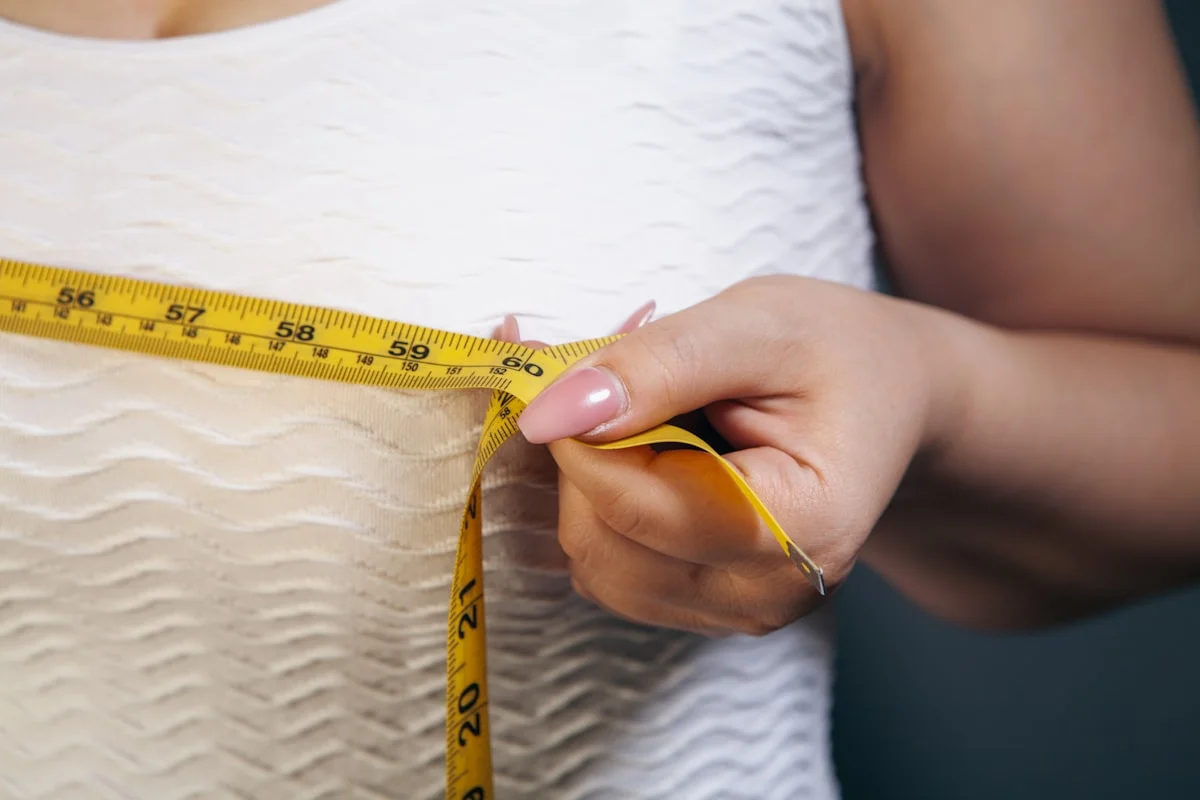
Bust
Where:
Around the fullest part of your chest, usually at nipple level. The tape goes straight across your back at the same height.
How:
Stand upright with arms relaxed at your sides. Wrap the tape and check in the mirror that it is parallel to the floor.
Common mistake: The tape rides up in the back. Use the mirror. If the tape is higher in back than front, adjust until it is level all the way around.
Waist
Where:
The narrowest part of your torso. This is typically 1-2 inches above your belly button, not at your belly button.
How to find it:
Bend sideways. The crease that forms is your natural waist. Straighten up, keep your finger on that spot, and wrap the tape there.
This is the #1 mistake most people make. If you are measuring at your belly button, you are measuring too low. A wrong waist alone can misclassify your entire body shape.
Hips
Where:
The widest circumference of your lower body, including the fullest part of your buttocks. Usually 7-9 inches below the waist.
How:
Stand with feet together (not apart). Wrap the tape at the widest point. If unsure, take two measurements and use the larger one.
Common mistake: Measuring at the hip bones instead of the actual widest part. The hip bones are not necessarily where your hips are widest.
Shoulders (Do Not Skip This One)
Where:
From the bony tip of one shoulder across your upper back to the other shoulder tip. This is across your back, not around your shoulders.
How:
Arms relaxed at your sides. Have someone hold the tape flat across your upper back. If alone, stand with back to a mirror and look over your shoulder.
Why does this matter? Shoulder width helps distinguish between inverted triangle and rectangle shapes. Without it, some body shapes look similar from bust, waist, and hips alone.
Body Shape Ratio Formulas
Once you have your four numbers, you can determine your body shape using these formulas. These are based on the FFIT methodology (Simmons, Istook & Devarajan, 2004).
Key ratios to calculate:
- Waist-to-Hip Ratio (WHR): Waist divided by Hips
- Bust-to-Hip Ratio (BHR): Bust divided by Hips
- Shoulder-to-Hip Ratio (SHR): Shoulders divided by Hips
Hourglass
Your bust and hips are nearly equal, with a clearly defined waist that is at least 8-10 inches smaller.
Formula: BHR between 0.95 and 1.05, and waist is 8-10+ inches smaller than hips and bust.
Example: Bust 36 inches, Waist 26 inches, Hips 36 inches
Celebrities: Marilyn Monroe, Scarlett Johansson, Christina Hendricks. About 8% of women have this proportions.
Pear (Triangle)
Your hips are wider than your shoulders and bust. The difference between your hips and waist is more pronounced than between bust and waist.
Formula: Hips divided by Shoulders is greater than 1.05, or hips significantly wider than shoulders.
Example: Bust 34 inches, Waist 28 inches, Hips 40 inches, Shoulders 15 inches
Celebrities: Jennifer Lopez, Beyoncé, Rihanna. About 20% of women have this body shape.
Inverted Triangle (Apple Top)
Your shoulders and bust are wider than your hips. The mirror image of the pear shape.
Formula: Shoulders divided by Hips is greater than 1.05, or shoulders significantly wider than hips.
Example: Bust 38 inches, Waist 28 inches, Hips 34 inches, Shoulders 17 inches
Celebrities: Natalie Portman, Alicia Vikander, Demi Moore.
Rectangle (Straight)
Your bust, waist, and hips are similar measurements. There is no dramatic difference between any two consecutive measurements.
Formula: BHR and WHR are both close to 1.0, and waist is less than 8 inches smaller than bust or hips.
Example: Bust 35 inches, Waist 28 inches, Hips 35 inches, Shoulders 16 inches
Celebrities: Kate Hudson, Cameron Diaz, Nicole Kidman.
Apple (Oval)
Your waist is the largest measurement, and your bust and hips are proportionally smaller.
Formula: Waist is larger than both bust and hips, or WHR is greater than 1.0.
Example: Bust 36 inches, Waist 34 inches, Hips 35 inches
Celebrities: Queen Latifah, Melissa McCarthy, Catherine Zeta-Jones.
Measurement Accuracy Troubleshooting
If your numbers seem off or change significantly between sessions, check for these common issues.
| Problem | Cause | Fix |
|---|---|---|
| Numbers change each time | Tape placement varies | Use body landmarks as reference points |
| Waist seems too large | Measuring at belly button instead of natural waist | Bend sideways, find the crease, measure there |
| Bust very different from bra size | Bra band size is not the same as full bust | This is normal, use full bust measurement |
| One side seems larger | Bodies are naturally asymmetric | Center the tape, average the circumference |
| Evening measurements larger | Water retention, food, activity | Measure in the morning for consistency |
| Shoulders hard to measure alone | Cannot see back tape placement | Stand with back to mirror, look over shoulder |
How to Record and Track Your Measurements
Whether you are measuring once for body shape identification or tracking fitness progress, keeping records helps you see patterns over time.
Measurement Record Template
| Date | Bust | Waist | Hips | Shoulders | Notes |
|---|---|---|---|---|---|
| Apr 14, 2026 | 36 in / 91 cm | 28 in / 71 cm | 38 in / 97 cm | 16 in / 41 cm | Morning, underwear only |
Always measure in the morning, in the same clothing, for consistent tracking.
What to Do With Your Numbers
Now that you have your four measurements, you have options for finding your body shape.
Use Our Free Calculator
Enter your numbers, get your body shape instantly with personalized styling tips. Takes about 30 seconds.
Learn the Ratio Formulas
Calculate WHR, BHR, and SHR yourself. Includes ratio thresholds, celebrity examples, and seasonal styling tips.
Not sure you want to measure at all? Our visual self-assessment guide can give you a rough idea of your shape without a tape measure.
Frequently Asked Questions
What tools do I need to measure my body shape?
A soft, flexible measuring tape (the kind used in sewing) and a full-length mirror. Optionally, a pen and notepad to record numbers, and a friend to help with shoulder measurements. Avoid using string and then measuring the string, as this adds error.
Should I measure over clothes or bare skin?
Measure over thin, form-fitting clothing like a fitted t-shirt and leggings, or over underwear. Thick fabrics, padded bras, or layers add volume and produce inaccurate results. For tracking changes over time, always measure in the same clothing.
How tight should the measuring tape be?
Snug against your body without compressing the skin. You should be able to slide one finger under the tape comfortably. Too loose gives inflated numbers, too tight gives numbers that are artificially small.
What time of day gives the most accurate measurements?
Morning measurements tend to be most consistent because your body has not been affected by food, water retention, or activity-related swelling. If morning is not possible, measure at the same time each session.
Can I measure myself or do I need help?
You can measure bust, waist, and hips alone with a mirror. Shoulder measurements are much easier and more accurate with a second person. If measuring shoulders alone, stand with your back to a mirror and look over your shoulder.
How often should I re-measure?
For body shape identification, one accurate session is enough. Your fundamental shape rarely changes unless you experience significant weight change, pregnancy, or hormonal shifts. For fitness tracking, measure every 4 to 6 weeks.
What if my tape measure is in centimeters?
Centimeters work just as well as inches. Body shape depends on ratios between measurements, not the unit. Just use the same unit for all four measurements and the math comes out the same.
Where exactly is my natural waist?
Your natural waist is the narrowest point of your torso, usually 1-2 inches above your belly button. The easiest way to find it: bend sideways and note where the crease forms. That crease is your natural waistline. Most people measure too low without realizing it.
Related Guides
Body Shape Calculator
Enter measurements, get your shape instantly
Body Shape by Measurements
Ratio formulas, shape chart, and styling tips
What Is My Body Shape?
Visual assessment without measuring tape
Body Proportions Calculator
How body proportions and key ratios work
Calculator with Shoulders
Includes shoulder width for more accurate results