Kibbe Soft Natural: Lines, Fabrics, and Outfit Formulas
Soft Natural is the Kibbe blend for a frame with a little width and blunt edges, softened by curves and rounded features. Here is what that means in practice, how to tell it apart from its two closest neighbors, and what to actually wear.
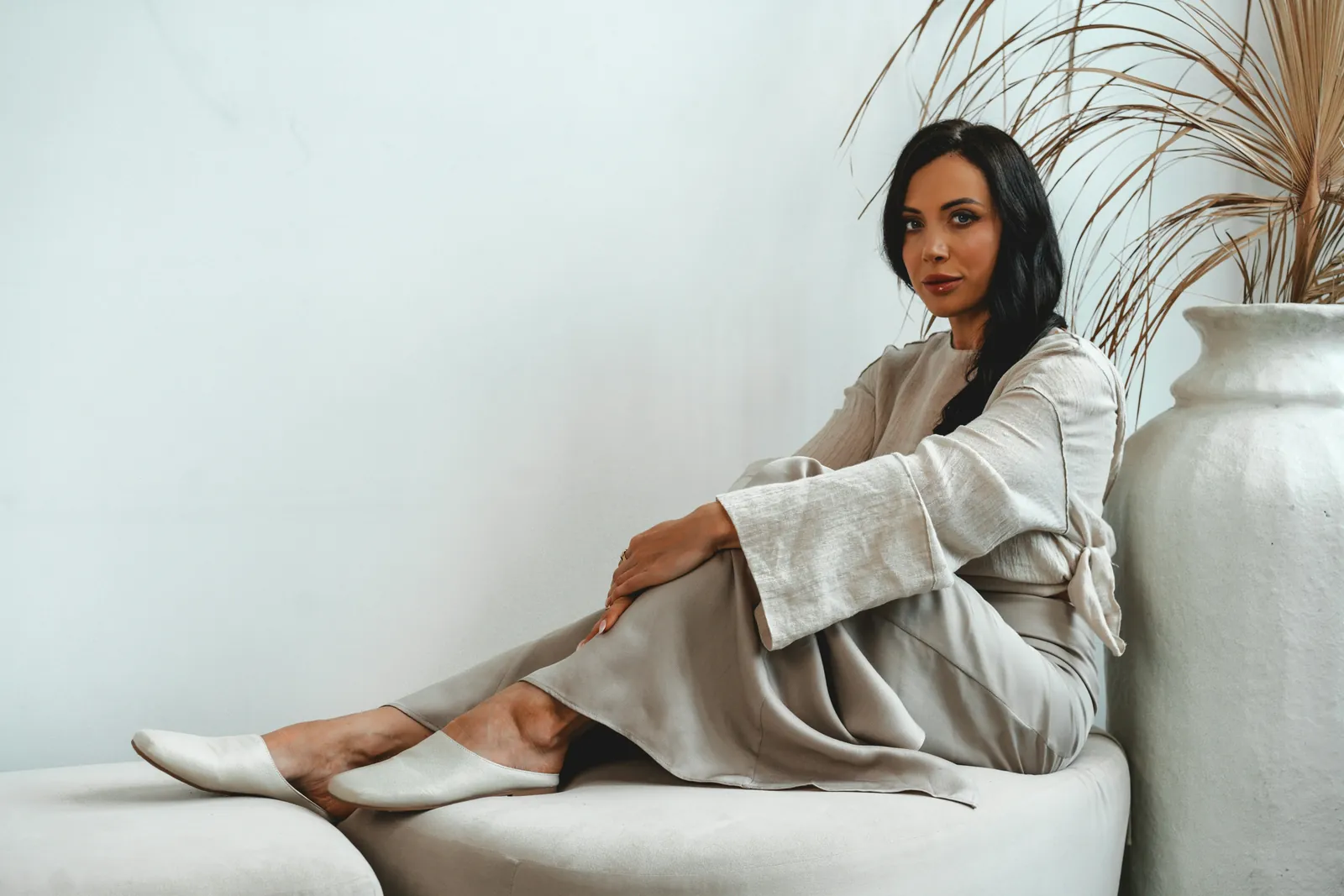
What Soft Natural Means in Kibbe's System
David Kibbe described 13 image identities in his 1987 book Metamorphosis. Each one sits somewhere on a yin/yang scale. Yang is the long, straight, angular end; yin is the soft, rounded, small end. In that original system the five pure types sit at fixed points (Kibbe's current 10-type system has retired three of them: Natural, Classic, and Gamine), and the blends mix one family's frame with another kind of softness or sharpness. Soft Natural belongs to the Natural family, the one built on blunt yang: width and a relaxed outline instead of the sharp edges of the Dramatic family.
What makes it "soft" is the yin undercurrent. The Concept Wardrobe, in its summary of Kibbe's descriptions, files the type under soft yang bone structure with yin body flesh and facial features. The frame is slightly angular, the shoulders slightly square or broad, and the body on top of it is gently curved with a waist that reads a little smaller than bust and hips. Faces tend to be full and rounded rather than chiseled.
Our own Kibbe body type test uses this definition for a Soft Natural result, word for word:
Soft Natural blends soft-yang bones with yin flesh. The system describes slightly angular bones with blunt edges, a slightly soft, curvy body that tends toward an hourglass outline, and full, rounded facial features: round eyes, full lips, soft cheeks. Kibbe introduced the blend in Metamorphosis (1987) as part of a styling framework about lines; it sits alongside, not instead of, a body-shape reading.
That last point matters. Kibbe types are about the lines of clothing that echo the lines of your body. They are not a size category and not a body shape. You can be a Soft Natural with an hourglass or a pear measurement profile, and your type does not change when your weight does. If you want the full map of all 13 types first, start with our guide to the Kibbe body types, then come back here.
Soft Natural vs Flamboyant Natural and Soft Classic
Soft Natural differs from Flamboyant Natural in length and curve, and from Soft Classic in symmetry. Most people who test as Soft Natural also wonder about one of two other types. Flamboyant Natural is the same family pushed further toward yang. Soft Classic is a different family with a similar amount of softness. The table lays out where they part ways, using the descriptions behind our test.
| Trait | Soft Natural | Flamboyant Natural | Soft Classic |
|---|---|---|---|
| Overall balance | Soft yang frame with yin flesh | Yang throughout, blunt rather than sharp | Balanced frame with yin softness |
| Shoulders and frame | Slightly broad, blunt edges | Broad, square, large scale | Tapered or slightly sloped, symmetrical |
| Body flesh | Soft and gently curved | Straight, tends toward muscle | Slightly rounded, even proportions |
| Vertical line | Moderate to slightly small | Long | Moderate |
| Best lines | Unconstructed with a soft waist | Long, oversized, relaxed | Smooth, symmetrical, softly tailored |
| Our test's yin/yang bar (0 yang, 100 yin) | 58 | 15 | 62 |
Against Flamboyant Natural, the gap is length and curve. Flamboyant Natural has a long vertical line, a larger and squarer frame, and flesh that stays straight or leans muscular. Its clothes can go big: oversized blazers, long relaxed maxi dresses, slouchy wide trousers. A Soft Natural in the same oversized pieces often looks swamped, because the cut ignores the waist. Keep the ease, shorten the scale, and add a soft point of shaping at the middle.
Against Soft Classic, the gap is symmetry. A Soft Classic frame is even and tapered, so smooth, matched, softly tailored outfits look polished on it. On a Soft Natural the same polish can feel a little stiff, as if the outfit is holding its breath. A slightly asymmetric drape, a looser weave, or a half tuck usually fixes it. One quick way to sort the two: if neat tailoring feels effortless, look harder at Soft Classic; if an easy wrap dress feels like home, look harder at Soft Natural.
Soft Natural Lines and Silhouettes
The Concept Wardrobe sums up the clothing line as unconstructed silhouettes with shaping, particularly at the waist, and relaxed lines with subtle drape and flow. Kibbe Body describes the same idea as an outline with breadth through the upper back that then moves around the curve, with any drape revealing the curves without being stiff or tight. In plain terms: room across the shoulders, a soft suggestion of a waist, and fabric that falls instead of standing up on its own.
- Tops. Relaxed blouses with soft collars or scoop and V necklines, wrap tops, drapey tees, and knits with a little give. A half tuck or a loose knot at the hem marks the waist without a hard line.
- Jackets. Unlined or lightly structured blazers with a soft shoulder and a slight nip at the waist. Skip heavy shoulder pads and very sharp lapels; a shawl collar or a rounded notch sits better.
- Trousers. Relaxed straight legs, soft wide legs, and tie or paperbag waists in fabrics that move. Rigid, razor-creased trousers can look severe.
- Skirts. Gently flared, wrap, and softly gathered midi skirts, plus bias-cut slip skirts in fluid fabric.
- Dresses. Wrap dresses, tie-waist shirt dresses, and loose dresses with a soft belt. The dress should follow the body without gripping it.
The details that help are the relaxed ones: tie closures, soft gathers, rolled sleeves, a little asymmetry. Kibbe Body's Soft Natural page puts it bluntly: nothing fussy. Rows of tiny ruffles or stiff bows add busyness without adding softness. Our hourglass body shape guide covers fit and proportion for curvy measurements, which pairs well with these lines if your numbers land there.
Fabrics, Textures, and Prints for Soft Natural
Soft Natural looks best in natural fibers that drape. The Concept Wardrobe recommends soft fabrics that drape and natural materials such as linen, wool, cotton, and silk. The common thread is a fiber that has some texture and some fall. Washed or slubby linen, brushed cotton, sandwashed silk, soft merino, and cashmere blends all qualify. Jersey and modal are useful for wrap shapes because they hold a drape and do not crease.
What tends to clash is stiffness and hard shine together. Crisp taffeta, very firm gabardine, and rigid structured satin hold their own shape, so they sit away from a curved body instead of following it. You do not have to give these up entirely; a crisp cotton shirt worn open over a soft tee, or a stiffer skirt with a fluid top, keeps one soft element in the mix.
For prints, think organic and blended: watercolor florals, soft botanicals, painterly abstracts, and relaxed geometrics with rounded edges, which is the phrase The Concept Wardrobe uses. Medium scale is the sweet spot. Color is a separate question. Kibbe Body splits the two: your haircut follows your image identity, while makeup and hair colors follow your Season, which comes from your natural coloring. So a Soft Natural with deep, warm coloring and one with light, cool coloring can share every silhouette in this guide and still wear very different palettes. Our color analysis tool helps with that half of the picture.
Soft Natural Outfit Formulas by Occasion
A Soft Natural outfit pairs an easy, unconstructed shape with a soft mark at the waist and fabric that moves. The six formulas below turn the lines and fabrics above into real outfits. Swap colors and brands freely; the structure is what carries the type.
| Occasion | Formula | Why It Works |
|---|---|---|
| Office | Unlined, softly shaped blazer in a wool blend over a drapey knit, with relaxed straight trousers or a gently flared midi skirt. | The jacket keeps a work outline without a stiff shoulder, and the knit adds the softness your frame asks for. |
| Weekend | Washed linen shirt, half tucked into soft wide-leg trousers or easy jeans, with a woven belt worn loosely. | The half tuck gives a waist without a crisp seam, and linen brings texture without stiffness. |
| Date night | Silk or satin slip skirt with a fine-gauge wrap top, a medium hoop, and a soft shoulder bag. | Fluid fabric moves with the curve, and the wrap marks the waist in a relaxed way. |
| Wedding guest | Tie-waist midi dress in crepe or chiffon with a soft floral or watercolor print, plus a rounded clutch. | A tie closure feels unconstructed, and the print scale stays medium so it holds against your frame. |
| Cold weather | Belted wrap coat in soft wool over a chunky but drapey sweater and a knit midi skirt, with slouchy boots. | The belt gives the coat a soft waist; a stiff, boxy coat flattens the curve into a straight block. |
| Travel | Jersey wrap dress with a long open cardigan and flat sandals or sneakers. | Jersey does not crease, the wrap keeps the waist, and the cardigan adds an easy, relaxed layer. |
A good test for any new outfit is to look at three places. The shoulders should have room and no hard edge. The waist should be suggested, by a tie, a wrap, a half tuck, or a soft belt, rather than sliced by a stiff waistband. The hem should move when you walk. When all three are true, the outfit almost always reads as Soft Natural, whatever the occasion.
Jewelry and accessories follow the same rule of moderate, rounded, and organic. A medium hoop, a pendant on a fluid chain, a woven or slouchy leather bag, and shoes with a rounded or almond toe fit the type. Very small, delicate pieces can look lost against a slightly broad frame, and very sharp geometric pieces can look harsh against the soft features.
How to Tell If You Are a Soft Natural
Five checks help you tell whether you are a Soft Natural: a structured test, your vertical line, your shoulders, where clothes fight you, and a one-week wardrobe test. Self-typing is hard, and plenty of people go back and forth between two neighbors for a while.
- Take a structured test. Our free Kibbe test scores every answer on one yin/yang scale and publishes its rules on the page. It returns Soft Natural when your vertical line reads moderate, your bone answers lean toward soft yang (broad and blunt rather than sharp), and your flesh and face answers lean yin.
- Check your vertical line. The Concept Wardrobe lists Soft Natural height as typically moderate to slightly small, up to about 5'7". Kibbe's later rule, as summarized by Kibbe Body, gives anyone 5'6" and over a vertical dominant. The two only disagree between 5'6" and 5'7". There the later rule applies, so at 5'6" or taller it points to a vertical-dominant type rather than Soft Natural. If you are tall and broad with little curve, read the Flamboyant Natural description too.
- Look at your shoulders in a fitted tee. Slightly broad with a blunt, squarish edge points to the Natural family. Narrow and tapered points toward Soft Classic or Romantic.
- Notice where clothes fight you. On a Soft Natural, sharp blazers tend to feel stiff, very oversized pieces swallow the curve, and fitted, ornate pieces look overdone. The relaxed middle ground, soft with a waist, is the one that feels easy.
- Run a one-week wardrobe test. Wear your softest, most relaxed waist-marked outfits for a few days, then your crispest tailored ones. Photos from the same spot and light make the comparison honest.
One caution: Kibbe's own approach has moved on since 1987. Kibbe Body notes that in his 2025 book Power of Style he steers away from checking individual body parts and toward sketching your overall line and watching how fabric falls on you. Treat any list of physical traits, including the ones above, as a starting hypothesis rather than a verdict.
Find your Kibbe type in two minutes
Not sure whether you are Soft Natural, Soft Classic, or Flamboyant Natural? Answer the questions on vertical line, bones, flesh, and face, and see exactly why you landed where you did. Pair the result with your measured body shape for fit decisions.
Frequently Asked Questions
What is a Kibbe Soft Natural?
Soft Natural is one of the blends in David Kibbe's image identity system, first set out in his 1987 book Metamorphosis. It pairs soft yang bones, meaning a frame that is slightly broad with blunt rather than sharp edges, with yin flesh and features: a soft, gently curved body and rounded facial features. The clothing lines that echo it are relaxed and unconstructed, with gentle shaping at the waist and fabrics that drape.
How is Soft Natural different from Soft Classic?
Both carry softness in the flesh, so they are easy to mix up. The difference sits in the frame. A Soft Classic frame is symmetrical with tapered shoulders and suits smooth, even, softly tailored lines. A Soft Natural frame is a little broader and blunter and suits looser, unconstructed lines with a soft waist. If a neat, matched twinset feels a touch prim on you and a half-tucked linen blouse feels right, lean toward Soft Natural.
What is the difference between Soft Natural and Romantic?
Romantic is rounded and delicate all the way through, with no width in the bones. Soft Natural shares the soft flesh and full features but keeps some blunt width in the shoulders and frame. That is why Romantic suits fitted, ornate, closely draped pieces, while Soft Natural looks more at ease when the same softness is cut a little looser and plainer.
What should a Soft Natural avoid wearing?
Nothing is off limits, but some lines fight the frame. Stiff, sharply tailored pieces with crisp edges tend to look severe. Very boxy shapes with no waist at all can lose the curve. Tiny, fussy details and very small prints can look lost against the broad frame. If an outfit feels like a costume, check whether it is too sharp, too stiff, or too shapeless and adjust one piece.
Can you be a Soft Natural at any size or height?
Size, yes. Kibbe types describe lines, not measurements, so a Soft Natural can wear any dress size. Height is different, because the system uses it to judge the vertical line. The Concept Wardrobe lists Soft Natural as typically moderate to slightly small, and Kibbe's later rule, as summarized by Kibbe Body, places anyone 5'6" and over in the vertical-dominant types such as Flamboyant Natural.
What jewelry suits a Soft Natural?
Moderate scale with rounded, organic shapes: hoops with a soft curve, pendants on a fluid chain, pebble or shell shapes, textured or brushed metal. Very sharp geometric pieces can look harsh, and very tiny pieces can disappear. One medium piece usually reads better than several small ones.
Which celebrities are Soft Natural?
Fan sites publish long lists, but we do not type real people from photos. Red carpet looks are built by stylists, cameras, and tailoring, so a photo tells you more about the clothes than about the frame underneath. A more useful check is your own mirror: try a soft wrap dress and a sharply tailored blazer and see which one looks like you.
Related Tools and Guides
Sources
Original system: David Kibbe, David Kibbe's Metamorphosis: Discover Your Image Identity and Dazzle as Only You Can (Atheneum, 1987), catalog record at Open Library.
Soft Natural bone, flesh, feature, height, and clothing-line descriptions: The Concept Wardrobe, The 13 Kibbe Body Types and Their Clothing Lines.
Silhouette description, color note, and the move to line sketching: Kibbe Body, Soft Natural.
Current 10-type system and the 5'6" vertical-line rule: Kibbe Body, Kibbe Types.